Precision in medical segmentation with composite loss functions
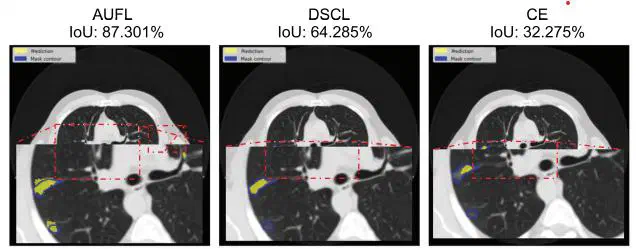
We have a new publication! Our latest paper focuses on analyzing how different loss functions impact the accuracy of medical segmentation with deep learning. Specifically, we evaluated three types (AUFL, DSCL and CE) applied to the detection of COVID-19 lung lesions in CT images, using advanced architectures such as TransUNet, ViT and U-Net.
The results are revealing: the AUFL composite loss function stands out for its accuracy and stability, consistently outperforming the others, especially when segmenting small lesions, such as ground-glass opacities (GGOs), so common in this pathology.
This publication consolidates a research line focused on improving models for precision clinical segmentation, with real applications in AI-assisted diagnosis and treatment scenarios. Our goal: to ensure reliable and reproducible segmentations, even in lower-resolution modalities such as CBCT.
Advancing precision in medical image segmentation: A performance analysis of loss functions for COVID-19 lung infection segmentation in computed tomography images is one of the outcomes of musicgenia, a project funded by Grant CPP2021-008491 from MICIU/AEI/10.13039/50100011033 and by the European Union through NextGenerationEU/PRTR.
Interested in understanding why AUFL achieves better results and how these functions compare across different architectures and imaging modalities? Contact us and we’ll explain it to you.