Music generation through deep learning
Abstract
Recent advances in deep learning have led to the development of new neural networks (models) specifically designed to process ordered data sequences: RNN (Recurrent Neural Networks), LSTM (Long-Short Term Memory, i.e., an enhanced RNN) and Transformers, whose performance has been impressive for generating content or patterns including music, text, audio, images and even source code. Additionally, new music datasets are available and play a key role in training. In this regard, projects such as Magenta (Google) provide open source software tools for use in content generation. Therefore, the technology ecosystem for generating, for example, AI-based music is reaching a level of maturity suitable for considering new business models. A clear example of this maturity is Apple’s recent acquisition of the startup AI Music, which uses Artificial Intelligence to generate personalized soundtracks and adaptive music. In this course, we will review in a theoretical and practical way these fundamental neural networks for generating content or patterns that can be created as humans would, introducing the most current tools and discussing the challenges that still lie ahead.
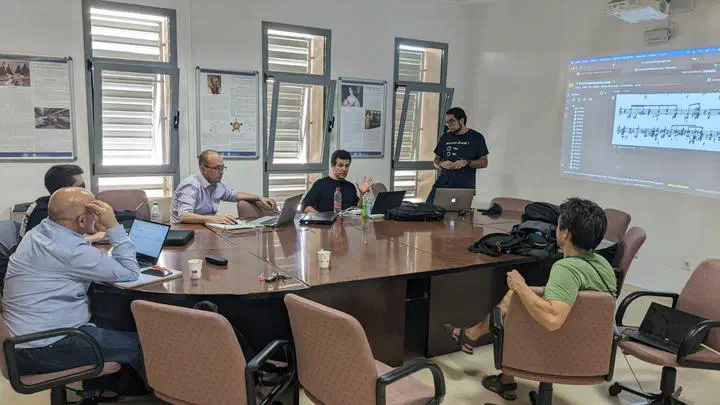
On November 3 and 4, as part of the Computer Science Doctoral Program at the University of Almería, Roberto Rodríguez Echeverría, University of Extremadura, delivered the course Content and/or recognizable pattern generation through neural networks, with the participation of Jorge Periánez Pascual, MetrikaMedia.
“It has been a while since relying on artificial intelligence to help us in our daily work stopped being a dream and became a reality. On a daily basis we use machine learning models to suggest the next words we type on our phones, to give just one example. What we never would have imagined is that these artificial intelligences would help us create creative content such as code for our programs, images following textual descriptions or, as we explain in this seminar, music,” commented UEx Associate Professor Roberto Rodríguez Echeverría.
The seminar content was as follows:
- Introduction to deep learning
- Recurrent Networks and Transformers
- Content Generation
- Image Generation with Variational Autoencoders
- Music generation with LSTM and Transformers
This and other seminars are the result of collaboration between industry and University. From i3lab, one of the working groups of Quercus Software Engineering Group, we are committed to training new engineers in subjects such as artificial intelligence and everything related to it, such as MLOps. Interested? Get in touch with us and let’s talk.
Roberto Rodriguez-Echeverria
INTIA Director and Associate Professor
Associate Professor at the University of Extremadura. Software passionate, Deep learner, MTB rider and father of 2.